AI Art: The Death of Creativity or a Digital Renaissance?
Explore how AI art is revolutionizing the visual world. Master generative techniques and try ISI Studio's professional tools to elevate your creativity today.
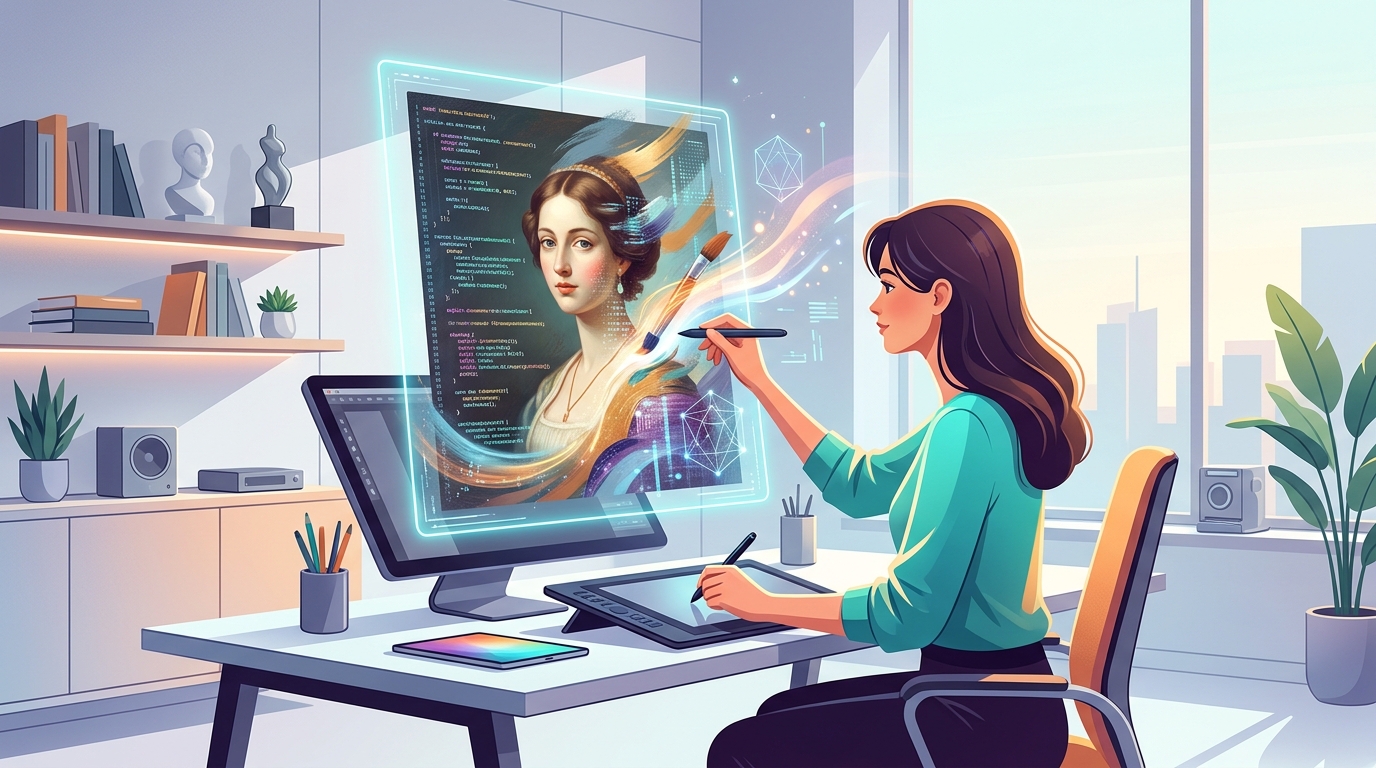
Beyond the Brush: When Algorithms Dream in Pixels
Standing before an empty canvas used to mean weeks of creative agony. Today? A few keystrokes produce a visual feast that once took masters months to achieve. Is this truly art, or merely a well-oiled statistical illusion? This question no longer belongs solely to philosophers; it is the daily reality for every graphic designer and digital creator. AI art hasn't just arrived; it has disrupted the status quo. We are witnessing a radical paradigm shift where technology is no longer just a tool, but a co-creator.
Order from Chaos: Inside the Digital Mind
A common misconception is that AI (Artificial Intelligence) simply creates collages from existing internet images. This is far from the truth. Modern algorithms, such as Diffusion Models (algorithms that build clear images from random noise), do not copy—they learn. They understand the nuances of Baroque lighting versus Cyberpunk neon. When given a command, the machine starts with white noise and gradually carves out forms until a crystal-clear image emerges.
This process occurs within the Latent Space—a multi-dimensional mathematical universe where the properties of images are stored. Here, there are no pixels, only mathematical relationships. When you ask for a "cat in a spacesuit," the algorithm finds the intersection of "cat-ness" and "space-readiness" within this infinite digital realm. This is the true magic of generative art: infinite variation where the only limit is your imagination—and, of course, your GPU (Graphics Processing Unit) capacity.
Democratizing Creativity or Devaluing Talent?
Art was once the privilege of a technical elite who spent years mastering anatomy and perspective. Today, a teenager can build visual worlds that previously required a Hollywood post-production house. Critics argue that AI removes the "soul" from creation, claiming art is defined by human struggle and imperfection. However, history repeats itself: when photography first appeared, painters feared the machine would kill art. Instead, painting evolved, and photography became a respected medium in its own right.
The bridge between machine and masterpiece is Prompt Engineering—the art of crafting precise instructions for AI. A professional AI artist must understand lighting, lens types, art history, and composition. Technology acts as a filter; only those with a genuine vision will stand out. Platforms like media.isi.studio are building this bridge, ensuring that creative vision, rather than technical limitation, remains the dominant force.
The New Workflow: Human-Machine Symbiosis
Forget the image of the lonely artist in an attic. Modern digital creation is a dialogue:
- Concept Development: The creator defines the core message and mood.
- Iteration: AI generates dozens of drafts in seconds, allowing the creator to select the most promising directions.
- Refinement: This is where Inpainting (modifying specific areas) and Outpainting (extending the canvas) come into play.
- Upscaling: Transforming the work into high-resolution formats for print or digital deployment.
This workflow is ten times faster than traditional methods, leaving more room for pure experimentation. If an idea fails, you haven't lost three days—only three seconds.
Video: The Next Frontier
If static image generation shocked the world, video generation will transform it entirely. We are moving beyond single frames into moving worlds. While generative video is in its infancy, its trajectory is staggering. A marketer no longer needs a full film crew for a 15-second mood video; using media.isi.studio tools, they can produce it in minutes. This efficiency is a competitive advantage that no modern business can ignore.
Does this mean the end for videographers? No. But the role of "editor" is evolving into "Visual Director"—someone who controls parameters rather than just cutting clips. This level of creative technology is about strategic vision, not just pushing buttons.
The Ethics of AI: Ownership in the Age of Algorithms
We cannot ignore the legal and ethical complexities. Regulation is currently trailing behind technology. If an AI is trained on images without explicit consent, is it theft? Courts worldwide are currently debating this. At present, AI-generated works often lack copyright protection unless significant human modification is involved. This presents both a risk for corporations and an opportunity for unique, hybrid creative solutions.
Then there is the issue of "Deepfakes." Responsibility lies with the creator. Just as we learned to be skeptical of airbrushed photos, we now need a new level of digital literacy. Transparency will be the currency of the future: taking pride in AI-assisted creation rather than hiding it.
Conclusion: The Future is Already Here
AI will not kill art, but it will kill mediocrity. Creators who master these algorithms will gain "superpowers" previously unimaginable. Technology is not the enemy; it is the most powerful brush ever placed in human hands. Do not fear it—embrace it. If you want to be among the first to harness the power of generative tools, visit media.isi.studio and experience how your thoughts can instantly become visual reality. In the future, the question won't be "Can you draw?" but "Do you have a bold enough idea?"
Glossary
- AI (Artificial Intelligence)
- Systems capable of learning and problem-solving, mimicking cognitive functions.
- Diffusion Model
- An algorithm that generates images by refining structured content out of random noise.
- Latent Space
- An abstract mathematical space representing compressed data where concepts are linked by proximity.
- GPU (Graphics Processing Unit)
- Hardware specialized for high-speed mathematical calculations required for AI and graphics.
- Prompt Engineering
- The process of optimizing text inputs to guide AI toward specific, high-quality outputs.
- Inpainting
- A technique used to repair or replace specific parts of an image using AI.
- Outpainting
- Extending an image beyond its original borders while maintaining context and style.
- Upscaling
- Using AI to increase image resolution while reconstructing lost details.
- Deepfake
- Highly realistic synthetic media where a person's likeness or voice is replaced by another using AI.