AI in CRM: Why Traditional Customer Management Is Dead
Revolutionize your customer experience with AI-driven CRM solutions. Boost revenue through automated insights and predictive scoring. Learn more today!
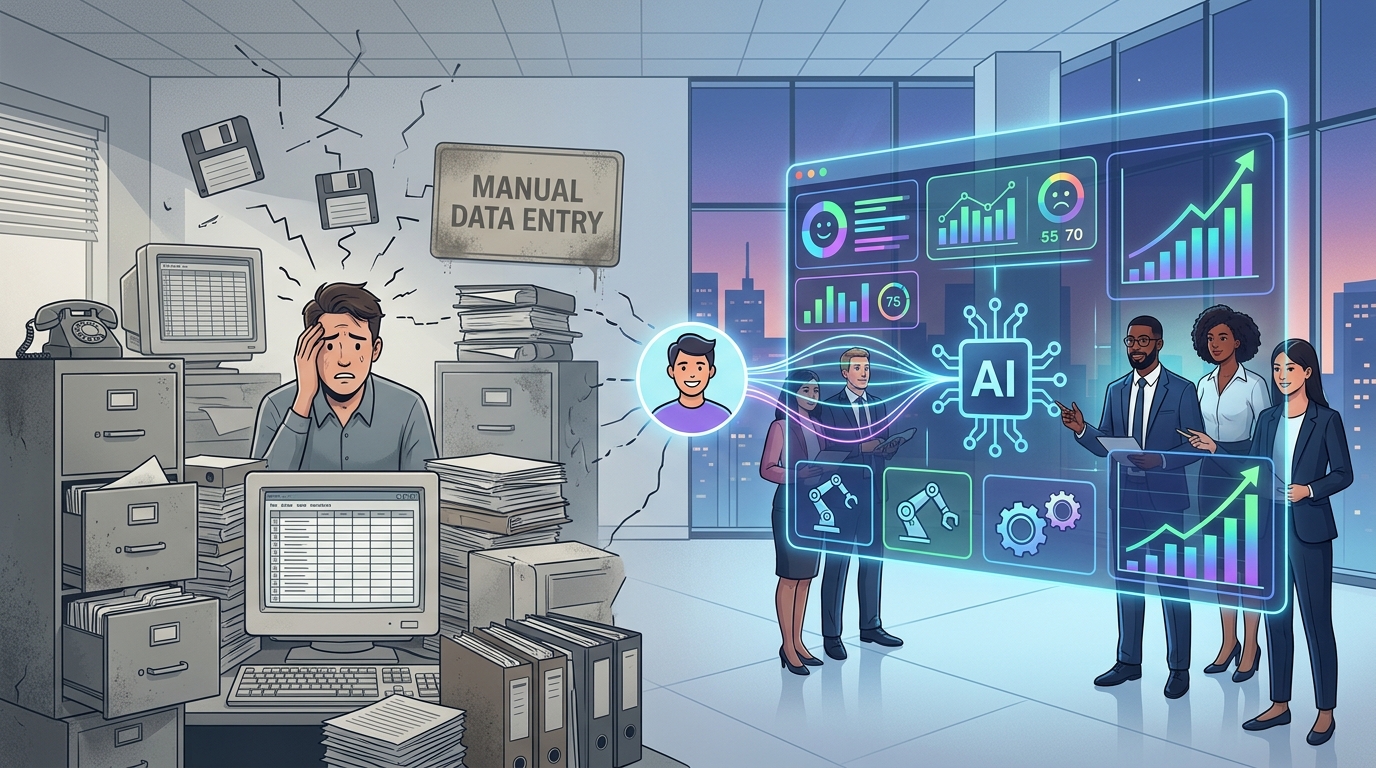
For most SMB owners, CRM (Customer Relationship Management) is nothing more than a digital graveyard where valuable data quietly rots in obscurity. Let’s be honest: sales teams hate administration. After an exhausting negotiation, who wants to spend twenty minutes typing notes into soulless software? The answer: nobody. This is exactly where businesses lose millions in potential revenue every year.
From Passive Databases to Proactive Intelligence
For the last decade, CRM systems were merely passive storage units. We recorded names, phone numbers, and perhaps a note that a lead likes coffee. But with the rise of AI (Artificial Intelligence), the paradigm has shifted. Today, we don’t just push data into the system; the system tells us what to do with the data. The core of AI-driven CRM is proactivity.
Imagine if your system didn’t just remind you to make a call, but analyzed the last three emails from a client and flagged a 70% probability of them churning to a competitor based on their tone. This isn’t science fiction; it is the reality made possible by modern NLP (Natural Language Processing). AI identifies hidden patterns that even the most experienced human eye would miss during the daily hustle.
The End of Admin: Automated Data Enrichment
The biggest barrier to CRM adoption is manual data entry. Sales teams can spend up to 30-40% of their time on tedious updates. This is where the concept of an AI-powered CRM plugin becomes transformative—automatically analyzing customer interactions. Such a tool doesn’t wait for you to type in a new phone number; it fetches it from public sources, updates job titles via LinkedIn, and logs calendar invites automatically.
In the visual age, customer experience is also aesthetic. When launching an automated campaign, AI can go beyond text. Using tools from ISI Studio, you can integrate unique visual content tailored specifically to a client’s brand. Imagine your CRM automatically generating a personalized video for a key partner, featuring their name and logo, without any human intervention.
Predictive Lead Scoring: A Data-Driven Crystal Ball
Which lead is worth your time today? This question determines whether you’re calculating commissions at the end of the month or explaining missed targets to your CEO. Traditional Lead Scoring is outdated—giving 10 points for a PDF download and 5 for a link click is too rigid for the modern buyer journey.
Modern AI solutions analyze thousands of variables simultaneously. They track the time of day emails are opened, seconds spent on specific web pages, and even use sentiment analysis to gauge enthusiasm during a demo. The result? A priority list based on hard data rather than gut feeling. Business intelligence is no longer about reporting the past; it’s about predicting the future.
Hyper-Personalization: Beyond "Dear [First Name]"
Today’s customers are immune to mass marketing. If an email feels generic, it’s deleted instantly. AI-powered CRMs enable hyper-personalization, adjusting every interaction to the customer's specific context. If the system detects a lead has been browsing articles on video marketing, your next outreach can automatically offer solutions like those found on the https://media.isi.studio platform regarding AI video generation.
This level of relevance builds deep trust. The client feels understood rather than "sold to." Furthermore, AI can draft immediate responses to inquiries or complaints, which a representative only needs to approve. This reduces response times to minutes—a critical competitive advantage in a high-velocity market.
- Personalized Content: Moving from templates to unique, context-aware responses.
- Real-Time Analytics: Instant feedback on customer satisfaction levels.
- Proactive Intervention: Identifying churn risks before the customer even leaves.
The Human Factor: AI as an Enabler, Not a Replacement
There is a common fear that AI will depersonalize commerce. We believe the opposite. By automating repetitive tasks—data entry, reporting, scheduling—the algorithm frees up the salesperson for what requires a human touch: empathy, strategic thinking, and genuine relationship building. An AI CRM isn’t a robot talking for you; it’s an elite executive assistant preparing every data point so you can be the superstar at the negotiating table.
Think about how many deals were lost because someone forgot a follow-up or missed a significant life event of a client. AI extracts these pivotal details from the noise. We aren't getting less human interaction; we are getting deeper, higher-quality engagement.
Implementation Strategy for SMBs
Don't try to overhaul your entire infrastructure overnight. The biggest mistake companies make is buying expensive enterprise software that no one knows how to use. Start small. Look for plugins or integrations that fit your existing workflow. Choose tools with robust APIs that connect easily to your marketing automation or visual content platforms like ISI Studio.
- Audit your data: Is your current database clean and usable?
- Target a specific pain point: Start with lead scoring or automated email drafting.
- Test with a pilot team: Validate the AI solution before a company-wide rollout.
- Measure ROI: Track time saved and increases in conversion rates.
The Final Verdict
The marriage of AI and CRM is not a passing trend; it is a prerequisite for business survival. Managing customers via Excel today is like entering a Formula 1 race with a horse-drawn carriage. You might eventually reach the finish line, but everyone else will already be on the podium. The data is in your hands—you just need the intelligence to make sense of it. Don't wait for the future; integrate AI into your processes today and leverage creative visual solutions to truly stand out.
Glossary
- AI (Artificial Intelligence)
- Systems designed to perform tasks that typically require human intelligence.
- CRM (Customer Relationship Management)
- Strategies and software used to manage all your company's relationships and interactions with customers.
- NLP (Natural Language Processing)
- A branch of AI that helps computers understand, interpret, and manipulate human language.
- Lead Scoring
- A methodology used to rank prospects against a scale that represents the perceived value each lead represents to the organization.
- API (Application Programming Interface)
- A set of rules that allows different software entities to communicate with each other.
- Hyper-Personalization
- The use of real-time data and AI to deliver more relevant content and product service offerings to every user.
- Churn Rate
- The rate at which customers stop doing business with an entity.