AI in Healthcare: The Future of Personalized Medicine
Discover how AI is revolutionizing healthcare through precision medicine and faster diagnosis. Read our expert analysis on the future of med-tech today!
The Silent Revolution Saving Lives
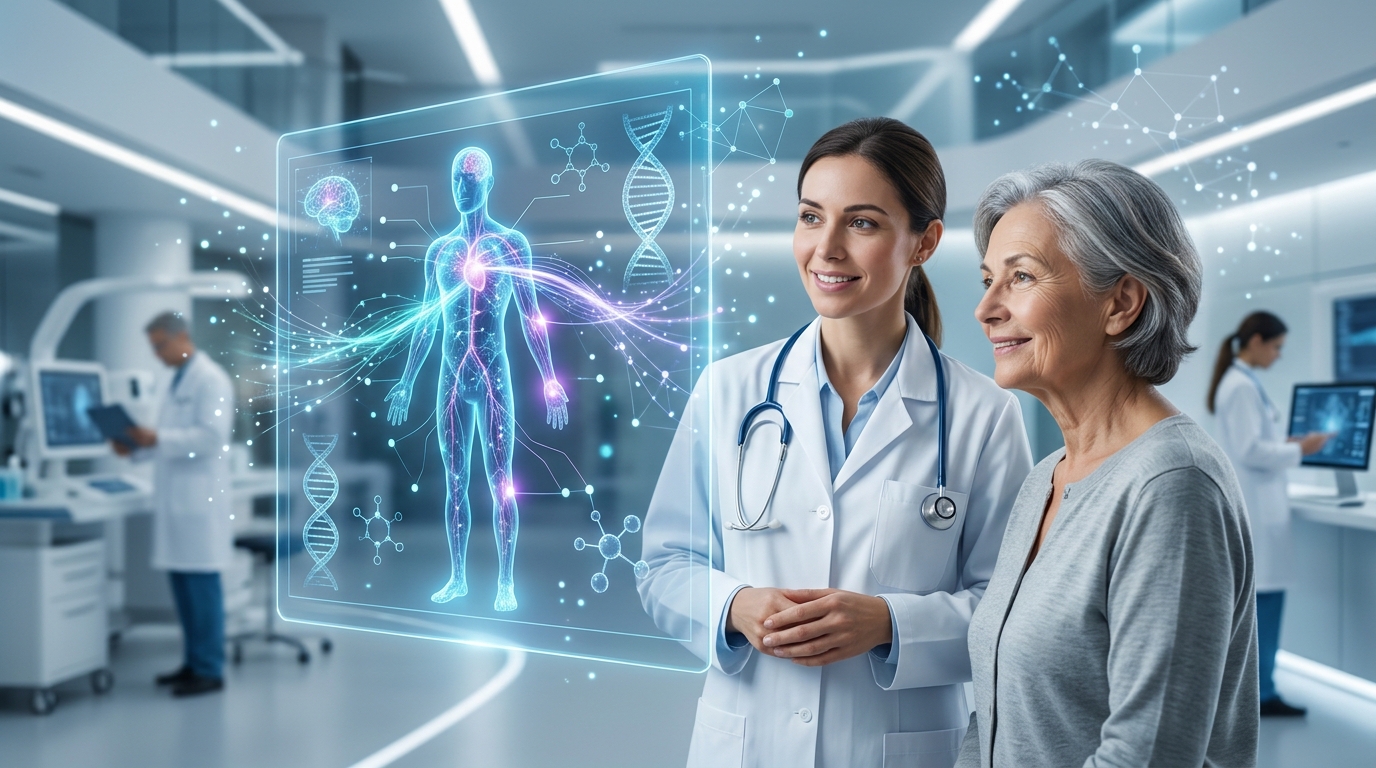
Imagine your doctor making life-altering decisions not based on a rushed fifteen-minute consultation, but through an algorithm that understands your unique genetic markers, every heartbeat from the last decade, and exactly how your body reacted to your morning coffee. This isn't an episode of Black Mirror; it is the reality currently arriving in hospitals and clinics worldwide. AI in healthcare is no longer just a technological buzzword—it is the final line of defense for a global care system pushed to its limits.
We often hear that doctors are overworked, but what if the solution isn't simply hiring more administrators? What if the answer is a machine that never tires, never gets hungry, and never misses a suspicious shadow on a lung X-ray during the twelfth hour of a shift? The data is clear: human error accounts for a significant portion of diagnostic mistakes due to biological limitations. AI, however, can cross-reference millions of patterns in seconds. But are we ready to entrust our most precious asset—our health—to an algorithm?
The Art of Diagnosis and Algorithmic Precision
Medicine is fundamentally about pattern recognition. An experienced radiologist might see 100,000 images in a career. A Deep Learning (a subset of machine learning using multi-layered neural networks) system can process that same volume in minutes, accessing global databases that aggregate worldwide expertise. AI does not replace the physician; it grants them "super-vision."
- Oncology: Algorithms are already rivaling top dermatologists in the early detection of skin cancer.
- Cardiology: By analyzing ECG data, AI can predict atrial fibrillation before a patient ever experiences a symptom.
- Radiology: Automated analysis of CT and MRI scans frees up doctors to focus on the most complex cases.
Consider a practical example. A Danish startup developed an AI that listens to emergency calls. The software monitors not just the words spoken, but the caller's tone, breathing patterns, and background noise. The result? It recognizes cardiac arrest with 93% accuracy, while human dispatchers average around 73%. These percentages represent lives saved. Much like how the media.isi.studio platform allows AI to transform complex visual concepts into images or videos instantly, healthcare AI extracts structured, life-saving information from chaos.
The End of "Standard Care": Welcome to Precision Medicine
For decades, we have taken the same aspirin for headaches and patients have received standardized chemotherapy as if every body were identical. It isn't. The essence of healthcare personalization is ensuring treatment is optimized for you, not the "average person." AI integrates genomic data (the complete set of your genetic information) with lifestyle factors. This is precision medicine.
How does this work in practice? If a patient is diagnosed with a tumor, AI can run simulations to determine which drug combination will be most effective against that specific mutation while causing the fewest side effects. This isn't guesswork; it’s pure mathematics and biology. For those who think this is far off, think again. In drug development, AI is already shortening research phases that previously took decades and billions of dollars by several years.
The AI Health Assistant: A Doctor in Your Pocket
This presents a massive opportunity: an AI-driven health assistant that doesn't just track your steps but interprets them. Current smartwatches are often data graveyards—they know your heart rate but can't explain why it spiked. A true AI assistant sees the correlation between sleep deprivation, rising blood pressure, and a looming flu.
This technology democratizes healthcare. Why wait weeks for routine advice when a validated AI, trained on medical databases, can provide immediate reassurance or urge you to visit the ER? This preventive approach can radically reduce hospital admissions. Visual communication is key here too: AI-generated educational videos, which can be created using technology like media.isi.studio, help patients visualize their condition, the healing process, or upcoming surgical procedures.
- Data Collection: Continuous monitoring via sensors and wearables.
- Analysis: Identifying patterns that deviate from the user's personal baseline.
- Intervention: Personalized alerts and lifestyle recommendations.
The Dark Side: Who Owns Your Genetic Soul?
We must address the risks. AI in healthcare requires an enormous appetite for data. Our medical records are the most sensitive information we possess. Who owns that data? The hospital? The software developer? Or the insurance company that might raise your premiums because an AI predicted a predisposition for diabetes ten years from now?
In the era of GDPR (General Data Protection Regulation), this is a critical debate. Technology moves faster than legislation. Without "Privacy by Design" and strict ethical guardrails, healing algorithms could easily become surveillance tools. This is a dilemma without easy answers, but the conversation cannot wait.
The Future of the Doctor-Patient Relationship
Many fear that AI will make healing impersonal. I believe the opposite. Currently, doctors spend up to 70% of their time on typing, administration, and bureaucratic processes. If AI takes over this burden, the physician can finally return to the reason they chose this profession: the patient. Technology doesn't replace empathy; it creates space for it.
Think about it: after an AI-assisted diagnosis, the doctor doesn't spend their time listing symptoms but explaining options and providing emotional support. AI answers the "what" and the "how," but the "why" and the human comfort will always belong to the doctor. The future of healthcare is a symbiosis: the cold logic of the machine paired with the warm empathy of the human.
In closing, ask yourself: would you trust your life to an algorithm if you knew it was 20% less likely to make a mistake than a human? The answer is likely yes, but building that trust is a journey. The technology is ready. Are we? To learn more about how AI is reshaping our visual world and communication, visit media.isi.studio, where the tools of the future are available today.
Glossary
- Deep Learning (DL)
- A specialized branch of machine learning that models the neural networks of the human brain to recognize complex patterns.
- Precision Medicine
- A medical model that proposes the customization of healthcare, with medical decisions, practices, and products being tailored to a subgroup of patients.
- Genomics
- The branch of molecular biology concerned with the structure, function, evolution, and mapping of genomes.
- GDPR
- The General Data Protection Regulation, a legal framework that sets guidelines for the collection and processing of personal information within the EU.
- NLP (Natural Language Processing)
- A field of AI that gives computers the ability to understand text and spoken words in much the same way human beings can.