SmartAligner: The Future of AI-Driven Orthodontics
Revolutionize your clinic with AI orthodontics and remote monitoring. Enhance efficiency and patient care with SmartAligner technology. Click to learn more.
The Chair Time Trap: Why Traditional Orthodontics Is Evolving
When was the last time a patient called to reschedule because they couldn't find parking, throwing your entire day's schedule into a tailspin? Or how many times have you conducted a 15-minute check-up only to confirm that everything is progressing exactly as planned? The answer is likely: too often. The traditional model, built on monthly recurring appointments, is not only a burden for the patient but also the least efficient way for a clinic to maximize revenue. Chair time is our most expensive resource, yet we frequently squander it on routine observations.
The shift toward digital is no longer just about convenience; it is an economic imperative. The integration of Artificial Intelligence (AI) in orthodontics has reached a point where algorithms do more than just assist—they proactively manage the treatment flow. The SmartAligner concept leverages digital dentistry to provide the clinician with a machine-learning partner that never tires and has analyzed millions of successful cases.
The SmartAligner Logic: How AI Learned to 'See'
At its core, this technology relies on predictive analytics. When a doctor designs an aligner sequence, they are essentially making a biomechanical prediction. They are stating that if this plastic appliance is applied to the teeth, they will move 0.25mm over two weeks. But what if they don't? Or what if they move faster?
This is where deep learning enters the equation. Today’s AI software can compare STL files (the standard format for 3D surface geometry) to bridge the gap between the virtual plan and reality. The algorithm analyzes the tooth surfaces, the projected root positions, and the gingival contours. It doesn't just look at images; it thinks in three dimensions. If a patient’s teeth are not following the aligner’s shape—a phenomenon known as off-tracking—the AI alerts the doctor immediately.
Think of it as having a dedicated orthodontic specialist sitting next to every patient 24/7. This level of precision is exactly what has disrupted the market for Invisalign alternatives. Today, the brand name matters less than the power of the underlying algorithm.
Remote Monitoring: The Assistant in the Patient's Pocket
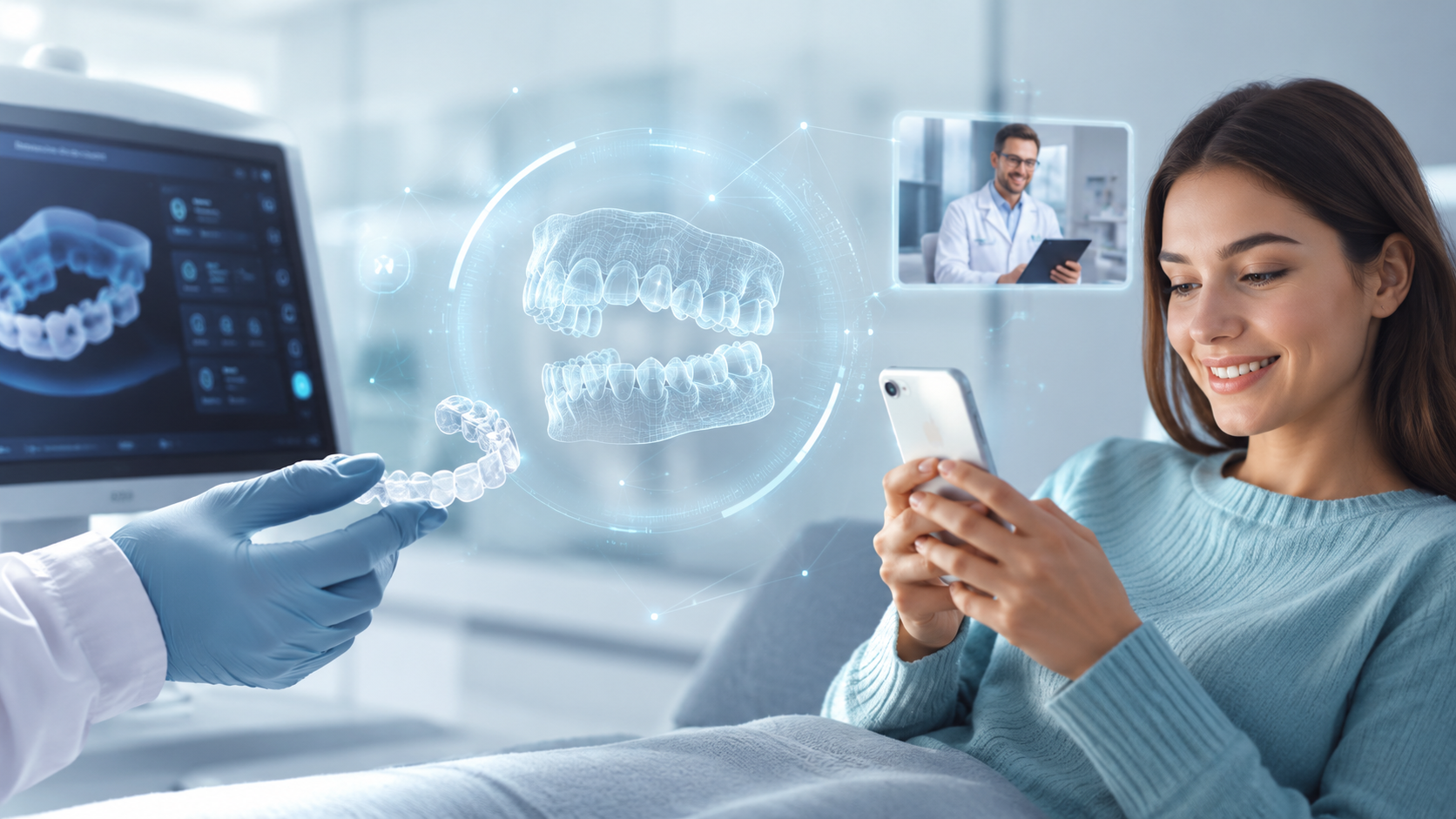
The most transformative area of digital dentistry is remote monitoring. The concept is simple yet disruptive: once a week, the patient takes photos of their teeth using their smartphone and a specialized cheek retractor. These images are uploaded to the cloud, where the AI immediately compares them to the digital treatment plan.
- If everything is on track: The patient receives a push notification: "Great job! Move to the next aligner."
- If there is a minor deviation: "Wear your current aligner for 3 more days and scan again."
- If a significant issue arises: Only then does a red flag appear on the clinician’s dashboard.
This triaging process radically increases a clinic’s throughput. A doctor who previously managed 200 patients can now responsibly oversee 500 without compromising quality. In fact, quality often improves because monitoring happens weekly rather than every 6 weeks. Errors, such as a non-tracking canine, are caught within 7 days instead of 45.
Does this replace the doctor? Not at all. It liberates the clinician from repetitive manual tasks. The orthodontist can finally focus on what they do best: complex diagnostics and strategic planning. For patient education, AI-generated visuals, like those created on the media.isi.studio platform, can be invaluable in explaining these high-tech processes.
The DTC Model: Threat or Greatest Ally?
It is time to address the "elephant in the room": DTC (Direct-to-Consumer) models. While many in the profession demonize them, the future belongs to a hybrid approach. Imagine a platform that uses AI to screen candidates before they ever set foot in a clinic.
This "filtering platform" doesn't aim to bypass the doctor. On the contrary, its goal is to route "clear-cut" cases (simple crowding or spacing) toward automated or remotely supervised workflows, while immediately delegating complex, surgical, or multidisciplinary cases to the appropriate specialist. This type of lead generation is worth its weight in gold for modern practices.
Patients no longer want to attend five consultations just to find out if they are a candidate for treatment. They want immediate answers. If an AI-powered app can tell them, "Yes, your result is achievable in 8 months, and here are the 3 nearest doctors to supervise it," everyone wins.
Digital Labs and Artificial Creativity
Digital dental laboratories are also evolving. They are no longer just "printing" aligners; they are becoming data stewards. Labs that utilize AI to optimize the sequence and geometry of aligners require fewer refinements (corrective aligners at the end of treatment). This translates directly into cost savings.
On the marketing front, AI is also taking center stage. A modern practice doesn't need generic stock photos; it needs personalized visual storytelling. Patients want to see the process. Using solutions similar to media.isi.studio, clinics can generate hyper-realistic demonstration videos and images that explain biomechanical movements without the need for expensive film crews. Building trust today relies as much on pixels and algorithms as it does on a firm handshake.
Closing Thoughts: The Symbiosis of Convenience and Precision
AI-driven orthodontics is not the future; it is the present. Clinicians who fail to invest in remote monitoring today will face a competitive disadvantage tomorrow—not necessarily because their neighbor is cheaper, but because they offer a more convenient and secure experience. Patients value not having to take time off work for a 5-minute visual check.
SmartAligner technology and the surrounding digital ecosystem allow dentistry to finally step out of the "craft industry" limitations and become a scalable, modern service. Are you ready to let AI be your most efficient assistant?
Glossary
- AI (Artificial Intelligence)
- Systems capable of performing tasks that typically require human intelligence.
- Aligner
- A clear, removable orthodontic appliance used to move teeth incrementally.
- STL File (Standard Tessellation Language)
- The standard file format used in 3D printing and digital dentistry to describe surface geometry.
- Biomechanics
- The study of mechanical laws relating to the movement or structure of living organisms.
- DTC (Direct-to-Consumer)
- A business model where services or products are sold directly to the end-user, often bypassing traditional intermediaries.
- Off-tracking
- A situation where the actual tooth movement does not coincide with the movement programmed into the aligner.
- Refinement
- The final phase of orthodontic treatment involving additional aligners to fine-tune the result.
- Lead Generation
- The process of identifying and cultivating potential patients for a clinic's services.