The Rise of AI Physics Tutors: Why Visual AI is the Future
Discover how AI physics tutors and multimodal models like GPT-4o are transforming learning. Experience 24/7 visual problem solving. Visit ISI Studio today.
Beyond the Sunday Night Hurdle: When AI Visualizes Gravity
Imagine the scene: it’s 11:00 PM on a Sunday. On the desk sits a cold cup of coffee, a crumpled physics workbook, and a student on the verge of a breakdown over a friction coefficient on an inclined plane. The private tutor is long asleep, and the parents' physics knowledge peaked at 'apples fall down.' Until now, there were two options: a desperate message to a Discord group or total defeat. But what if your smartphone camera didn't just photograph the chaos, but actually understood it?
Technology has reached a tipping point where the AI physics tutor is no longer a sci-fi prop. Multimodal AI—models like GPT-4o capable of processing text, images, and audio simultaneously—is dismantling the traditional educational hierarchy. We are no longer talking about a rudimentary chatbot where you type in variables. We are witnessing the rise of a digital entity that 'sees' hand-drawn diagrams, recognizes messy equations, and explains the conservation of momentum as if Richard Feynman were sitting on the sofa next to you.
Why Text-Based Help Failed and Visual AI Wins
Physics is not a literary subject. It cannot be fully captured in words; physics is spatial, visual, and dynamic. Anyone who has tried to textually describe an electromagnetic induction experiment to an AI knows how much is lost in translation. Students don't just need a final answer—Google can provide that in half a second. They need the 'why' and the 'how.'
Today’s learners are digital natives socialized on visual platforms. The surge of 'Study with Me' content proves there is a massive demand for interaction and visual reinforcement. A modern visual problem solver fills this gap perfectly. When a student holds their camera over a notebook, the AI uses advanced OCR (Optical Character Recognition) to not only read the text but to map the elements in space. It understands that an arrow indicates a vector's direction and knows that hatching symbolizes ground friction.
The Crisis of the Traditional Tutoring Model
Let’s be honest: private tutoring has become a luxury good and a logistical nightmare. High hourly rates and scheduling conflicts make it inaccessible for many. In contrast, an AI-powered solution is available 24/7, never tires, and never judges if a student needs the work-energy theorem explained for the fifteenth time. The goal isn't to eliminate the human element, but for 'homework help' level tasks, AI is simply more efficient, scalable, and democratic.
How the Future of EdTech Apps Works
What does this look like in practice? We are seeing business concepts where the mobile camera acts as the 'eyes' of the tutor. The process doesn't end with a solution. The user points their phone at a handwritten problem, the app recognizes the inputs, and then asks: 'Would you like to see the full derivation, or just a hint for the next step?'
- Step-by-Step Guidance: The AI doesn't just dump the answer. It guides: 'Look here, you forgot to account for air resistance. Try rewriting the equation with this new force!'
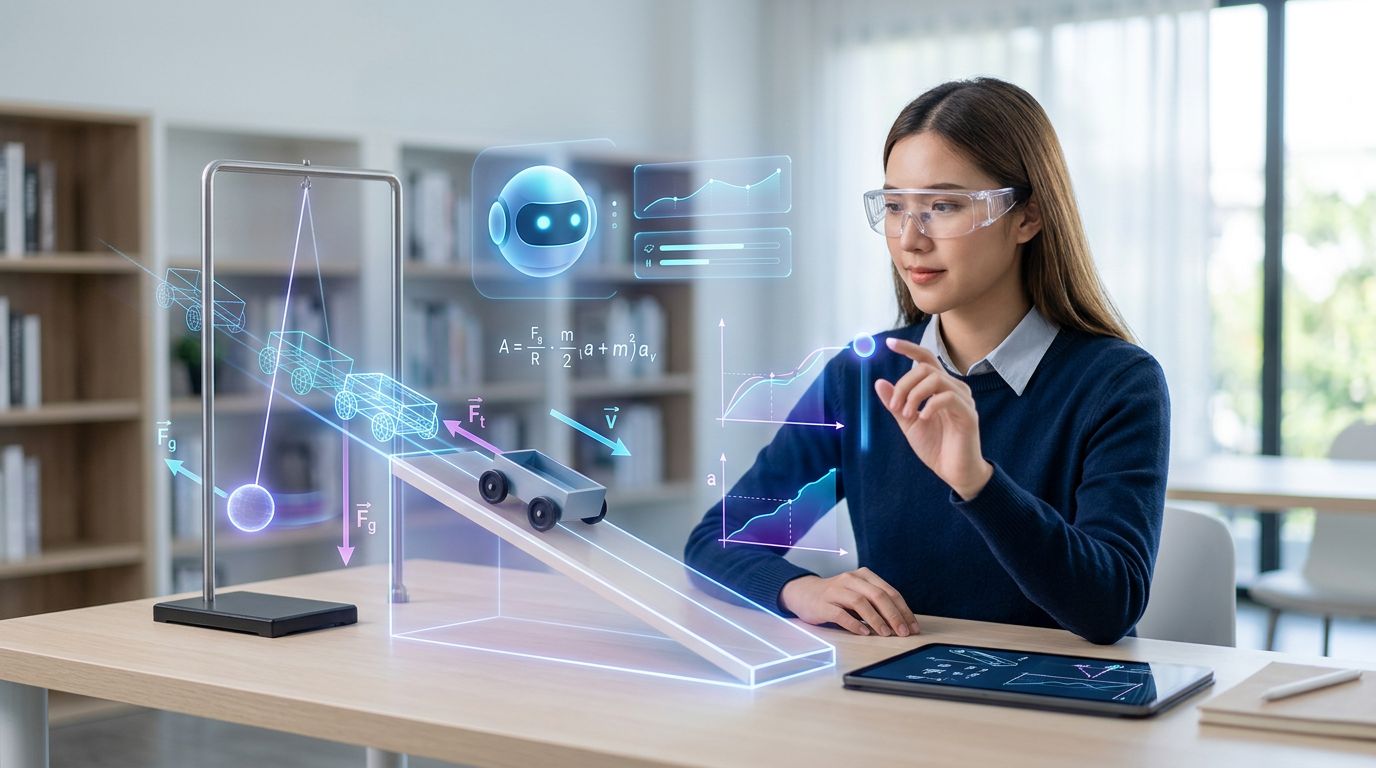
- Visual Simulations: If a student struggles with projectile motion, the app can overlay an animation directly onto their notebook using AR (Augmented Reality) technology.
- Personalized Explanatory Styles: Users can choose their tutor’s persona, from a formal professor to a relatable peer mentor.
This type of multimodal learning is brilliant because it engages multiple senses simultaneously. Sight and sound are linked with action (as the student writes the next line). When it comes to creating these visual aids, technology is advancing rapidly. For those looking to produce their own educational videos, the media.isi.studio platform allows for the generation of professional visual content and avatars in minutes.
The 'Cheating' Debate: Is AI Making Students Lazy?
This is the most common pushback: 'But then they won't think for themselves!' This technophobia mirrors the introduction of pocket calculators in schools. Critics feared no one would learn to add. In reality, calculators paved the way for more complex mathematical problem-solving because energy was no longer wasted on routine computation.
Visual homework help is actually 'augmented intelligence.' If a student is stuck and has no help, they stop learning out of frustration. If they receive a slight nudge in the right direction, they continue. AI acts as a catalyst, not a replacement for the brain. The real question isn't whether students are cheating, but why we still demand dry, mechanical tasks that a machine can solve. Education must shift from rote memorization toward creative problem-solving.
ISI Studio and the Power of Visual Content
The visual revolution extends beyond textbooks. Just as AI can recognize physics diagrams, it can also create them. This is where media.isi.studio provides a critical advantage: using cutting-edge generative algorithms to transform abstract concepts into tangible visual experiences. Whether you are a physics teacher wanting more engaging slides or a developer building the next big EdTech app, professional visual content production no longer requires a full design team.
One of the greatest benefits of visual AI-supported learning is inclusivity. For students with dyslexia or ADHD, walls of text are daunting. For them, an interactive diagram or an AI-generated explainer video can be the difference between failure and academic success. ISI Studio’s technology ensures these visual aids are not just functional, but aesthetically engaging—critical for maintaining student attention.
Conclusion: The Era of Personalized Education
In the future, there will be no 'average' curriculum. AI will know that a specific student excels at mechanics but struggles with optics, providing more visual scaffolds exactly where they are needed. This level of personalization is a physical impossibility for a human teacher in a classroom of thirty. But for a smartphone? It’s a routine task.
Is the era of the private tutor over? Not necessarily. But their role is transforming radically. They must become mentors and coaches focusing on deep connections and motivation, while the 'how do I calculate voltage' questions are handled by visual AI. This shift may be painful for those relying on routine, but it is liberating for those who truly want to teach.
Don't fear the AI in the backpack. Instead, teach students how to master it. The student who learns to prompt an AI to solve a complex physics problem today will be the professional who navigates any technological hurdle tomorrow. And if they need extra visual inspiration or professional content along the way, media.isi.studio will always be in their toolkit.
Glossary
- AI Physics Tutor
- AI-powered software or applications specifically designed to solve and explain physics problems.
- Multimodal AI
- An artificial intelligence model capable of processing and managing multiple data inputs (text, image, audio, video) simultaneously.
- GPT-4o
- OpenAI's latest multimodal model, where 'o' stands for 'omni,' referring to its comprehensive processing capabilities.
- OCR (Optical Character Recognition)
- Technology that converts printed or handwritten text within images into machine-readable text.
- Visual Problem Solver
- An algorithm that draws logical conclusions based on visual information, such as a hand-drawn diagram.
- AR (Augmented Reality)
- Technology that overlays digital information (images, 3D models) onto the real world via a screen or specialized glasses.
- Multimodal Learning
- An educational method using multiple sensory channels and information types (visual, auditory, textual) to transfer knowledge.
- EdTech (Education Technology)
- The application of technological tools and software to make the learning process more efficient.