AI Video Dialogue: The New Revolution in Content Production
Master AI video dialogue: save costs and generate professional videos in minutes. Experience natural automation and seamless scaling at ISI Studio. Try it today!
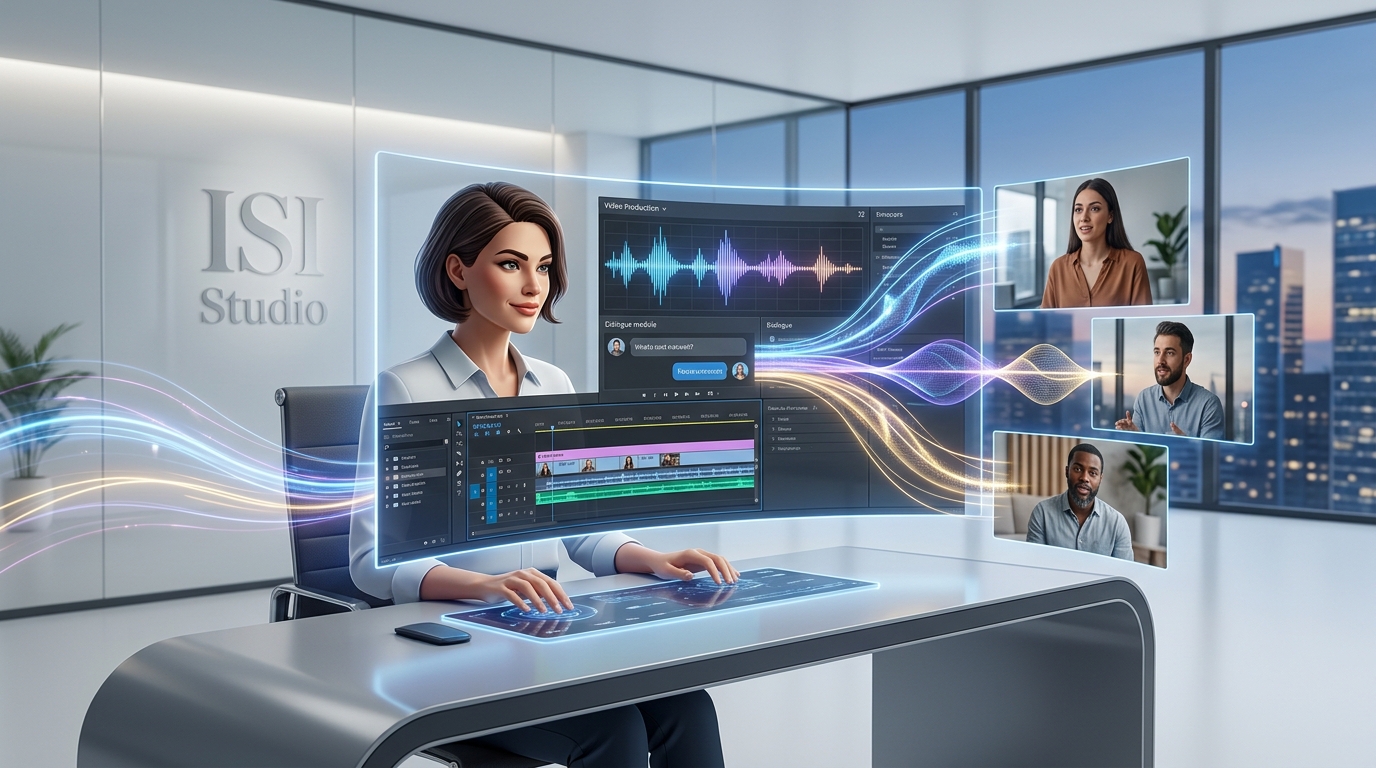
Beyond Subtitles: The End of the Digital Stone Age
Let’s be honest: how many times have you closed a video in the first three seconds because the narrator’s voice sounded like a depressed vacuum cleaner trapped in a box? For years, content creators in smaller markets lived in this bleak reality. They either paid a fortune for a professional voice actor or settled for robotic, metallic voices that instantly undermined even the most professional visual material. But in recent months, something deep within the code has changed. Dialogue AI has suddenly learned to feel, to emphasize, and most importantly: to sound human.
This is not just another software update; it is a paradigm shift. When an algorithm can track the specific melody of a language, catch ironic inflections, or master the subtle rise at the end of a question, it stops being mere technology and becomes art. For video producers, this means that post-production work that previously took days is now shortened to minutes. Imagine that after writing your script, you don't reach for the phone to book a studio, but simply type the text and a natural, professional voice responds immediately.
The Ultimate Litmus Test for Artificial Intelligence
Why did we wait so long for this? Anyone who has studied a complex language knows it can be a nightmare for logic-based systems. Agglutinative structures (where prefixes and suffixes change meanings), free word order, and context-dependent nuances have historically defeated most neural networks. While English AI systems have been proficient for years, other languages were often treated as distant dialects that only needed to be translated "well enough."
The breakthrough came when new-generation models moved away from static dictionaries toward deep learning to master linguistic dynamics. Today’s Marketing AI understands context—it knows when a phrase is enthusiastic and when it is sarcastic. This context-dependent interpretation allows generated dialogues to avoid the trap of the Uncanny Valley (the phenomenon where a non-human entity looks or sounds almost human, but its imperfections cause a sense of unease).
Seamlessly Integrating AI into Your Workflow
Consider a practical example: a small business wants to create a tutorial video for their new software. In the past, this required scriptwriting, microphone rental, fifteen failed takes, noise reduction, and heavy editing. Today? They enter the text into a platform like ISI Studio, select the right character, and the system generates not only the voice but even matching visual content. This type of automated video generation allows a single creator to produce as much material as a full-scale studio once did.
- Cost-Efficiency: No need for studio rentals or expensive sound engineers.
- Agility: Modifications are instantaneous. If a product name changes, simply edit the text and re-generate.
- Scalability: Producing ten videos a day requires no more energy than producing one.
The "Business Idea": The Automated Video Agency
This is where the real business opportunity lies. Having software capable of generating natural dialogue doesn't just produce a video; it revolutionizes an entire service sector. Small and Medium-sized Enterprises (SMEs) were previously priced out of professional video marketing due to high entry barriers. An AI-based video production suite removes that barrier.
Consider the concept of the "Automated Influencer." You can create virtual characters who present daily news, product reviews, or company briefings with perfect articulation. The tools at ISI Studio already enable image and video generation, but the integration of dialogue AI is the true catalyst. When visual content and audio are in perfect sync, the audience stops wondering if they are watching a machine and starts focusing on the message.
The Psychology of Voice: Why Natural Sound Drives Conversion
In marketing, trust is the most valuable currency. If a promotional video sounds artificial, the viewer's brain sends an immediate warning: "Caution, this isn't authentic." Natural dialogue AI is crucial because it breaks down this psychological barrier. ROI (Return on Investment) improves drastically when the audience feels like a real expert is speaking to them. Statistics show that videos with natural-sounding narration have retention rates up to 40% higher than robotic versions.
Furthermore, during content generation, AI is capable of nuances that a tired human might miss. It can deliver the same sentence for the tenth time with the exact same level of enthusiasm. This consistency is the cornerstone of branding. Beyond that, clarity is improved: the AI doesn't mumble, doesn't trip over words, and articulates perfectly every time.
The Future: Hyper-Personalized Dialogue at Scale
What comes next? The next step is hyper-personalization. Imagine an e-commerce store that doesn't just send one generic promo video to all customers, but instead generates a unique offer for each person, addressing them by name. "Hi Peter, we saw you were looking at these shoes..."—delivered in a pleasant, persuasive voice in real-time.
This level of automation is no longer the distant future; it is the present. Platforms like media.isi.studio are constantly pushing the boundaries of generative AI. The question is no longer whether AI can replace certain processes, but who will be the first to capitalize on this competitive advantage.
Glossary
- AI (Artificial Intelligence)
- Systems capable of performing tasks that typically require human intelligence.
- Agglutinative
- A linguistic type where complex words are formed by stringing together grammatical morphemes.
- ROI (Return on Investment)
- A performance measure used to evaluate the efficiency of an investment.
- SME / KKV
- Small and Medium-sized Enterprises.
- Uncanny Valley
- The dip in human likeness where a near-perfect imitation of a human becomes eerie or repulsive.
- Content Generation
- The process of creating digital material (text, image, video) using automated tools.
- Marketing AI
- The application of AI in marketing strategies and campaigns to optimize results.
- Neural Network
- A series of algorithms that endeavors to recognize underlying relationships in a set of data through a process that mimics the way the human brain operates.