AI Video-to-Mindmap: The Future of Visual Learning
Transform videos into visual maps with AI. Discover how Napkin.ai and ISI Studio revolutionize visual learning for professionals. Boost your ROI and try it now!
The Death of Linear Information: Why Traditional Note-Taking Fails
Let’s be honest: how many times have you sat through a two-hour YouTube lecture only to realize you haven't retained a single coherent thought? The problem isn't your intelligence; it’s the outdated format of data delivery. Video is linear. Our brains—especially those wired for engineering and programming—are networked. When trying to understand a complex system, we don't need lines of text; we need connections, hierarchies, and nodes.
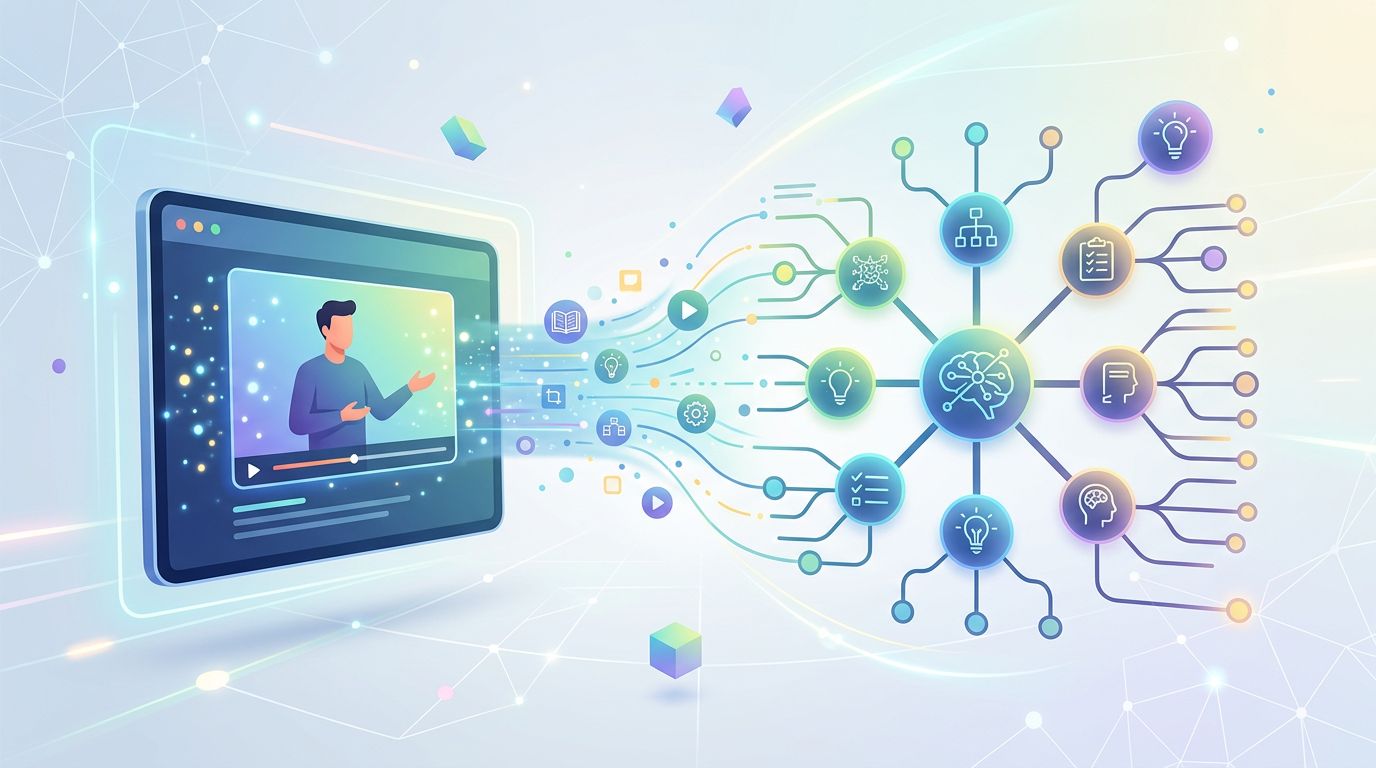
Video-to-mindmap visualization is not just another convenience feature; it is a cognitive revolution. Imagine attending a dense 90-minute technical course without the need for frantic typing. Instead, an AI (Artificial Intelligence) works in the background, monitoring the audio, identifying key concepts, and drawing the logic map in real-time—a task that would normally take you hours. This visual knowledge representation has become a baseline requirement in a world where information grows exponentially while our attention span remains finite.
The Rise of the Visual Learner
For engineers and developers, text transcripts are often just noise. If someone is explaining Kubernetes architecture, we don't want to see words; we want to see how a Pod connects to a Service. This is where technology powered by Natural Language Processing (NLP) comes in, interpreting speech within its proper context. It doesn't just list keywords; it understands the "why" and the "how."
Building Your Visualization Engine: The Modern Tech Stack
If you are a developer or a product manager, the question is no longer whether this is possible, but how quickly you can integrate it. A modern workflow no longer requires a dedicated supercomputer. The process looks like this:
- Audio Extraction: Downloading the video and stripping the audio track.
- Transcription & Diarization: Converting speech to text while distinguishing between speakers using high-level models similar to those available on the ISI Studio platform.
- Semantic Analysis: Utilizing an LLM (Large Language Model) like GPT-4o or Claude 3.5 to analyze the text and extract a hierarchical structure.
- Visual Mapping: Passing the data to an API (Application Programming Interface) such as Napkin.ai or Mermaid.js to generate the final mindmap.
Why Napkin.ai? Because this tool can transform dry data structures into aesthetic, presentation-ready visual elements. Engineers need more than just data; they need clarity. Integrating this feature into a B2B (Business-to-Business) training platform causes user engagement to skyrocket. No one wants to read a 50-page PDF when they can interact with a single, comprehensive diagram.
A Business Goldmine: Licensed Solutions and B2B Training
The saying "content is king" is becoming obsolete. Today, "context is king." Those who can transform existing libraries of corporate training videos into visually digestible formats own the future. Consider onboarding at a multinational corporation: fresh engineering graduates are often assigned dozens of videos. What if those videos were automatically accompanied by a logic map?
This technology works perfectly as a licensed service. Any course creator aiming for premium pricing needs a SaaS (Software as a Service) video-to-mindmap tool. The instructor uploads the video, and the AI handles the heavy lifting: creating outlines, mindmaps, and visual aids that can be further refined using ISI Studio tools to match brand identity.
Efficiency vs. Laziness: Does AI Hinder Critical Thinking?
Let’s pause. Some argue that if AI "pre-chews" information, we lose our ability to think critically. I disagree. A mindmap does not replace understanding; it provides a navigational map. It’s like GPS for your brain. Knowing the route doesn't mean you don't have to drive. Visual networks help avoid "cognitive overload," allowing you to spend your energy on analyzing deeper connections rather than the logistics of note-taking.
Technical Depth: RAG and Context Preservation
The greatest challenge isn't drawing the map—it’s accuracy. RAG (Retrieval-Augmented Generation) technology ensures the AI doesn't just rely on its general training but works specifically from the video source material. This is critical in engineering fields where a single missed parameter can be catastrophic.
When processing a complex engineering lecture, the AI must understand specialized terminology. If a speaker mentions "latency," the system must know where that sits within the network topology. Much like the development environments at ISI Studio, precision is key. Every element of the generated mindmap should be traceable back to a specific timestamp in the video. This is the pinnacle of "interactive learning": click a node, and the video jumps to that exact moment.
The Market Hunger for Visualization
While AI image and video generation have evolved rapidly, structured knowledge transfer has lagged behind. Visual learners (representing roughly 65% of the population) have been neglected in a text-heavy world. Now, technology has finally caught up with demand.
Entering this market now means you aren't just selling software; you are selling time and mental bandwidth. In the B2B sector, this is the most valuable currency. If AI helps a developer master a new framework in 30 minutes instead of 3 hours, the ROI (Return on Investment) is immediate and undeniable.
Conclusion: Your Next Step
Video-to-mindmap technology is not a distant vision—it is here. Linear learning is slow and inefficient. If you are an educator, content creator, or business leader, ask yourself: how much longer will you overwhelm your team with indigestible data? AI can make knowledge visible and tangible. Don't just watch the video—understand its architecture.
To explore how to transform your own visual content or leverage the creative potential of AI, visit ISI Studio, where cutting-edge generative solutions take your projects to the next level. The future belongs to those who can see the connections.
Glossary
- API (Application Programming Interface)
- A set of rules that allows different software applications to communicate with each other.
- B2B (Business-to-Business)
- Commercial transactions and services conducted between companies.
- LLM (Large Language Model)
- An AI model, like GPT, trained on vast amounts of text to understand and generate human-like language.
- NLP (Natural Language Processing)
- A field of AI focused on the interaction between computers and human language.
- RAG (Retrieval-Augmented Generation)
- A method that allows AI to retrieve data from specific external sources to provide more accurate answers.
- ROI (Return on Investment)
- A performance measure used to evaluate the efficiency or profitability of an investment.
- SaaS (Software as a Service)
- A software distribution model where applications are hosted by a provider and made available to customers over the internet.