How AI Agents are Revolutionizing Marketing Profitability
Learn how autonomous AI agents can slash marketing costs by 80%. Discover the WaaS model and how to scale your agency with AI-driven workflows in 2025.
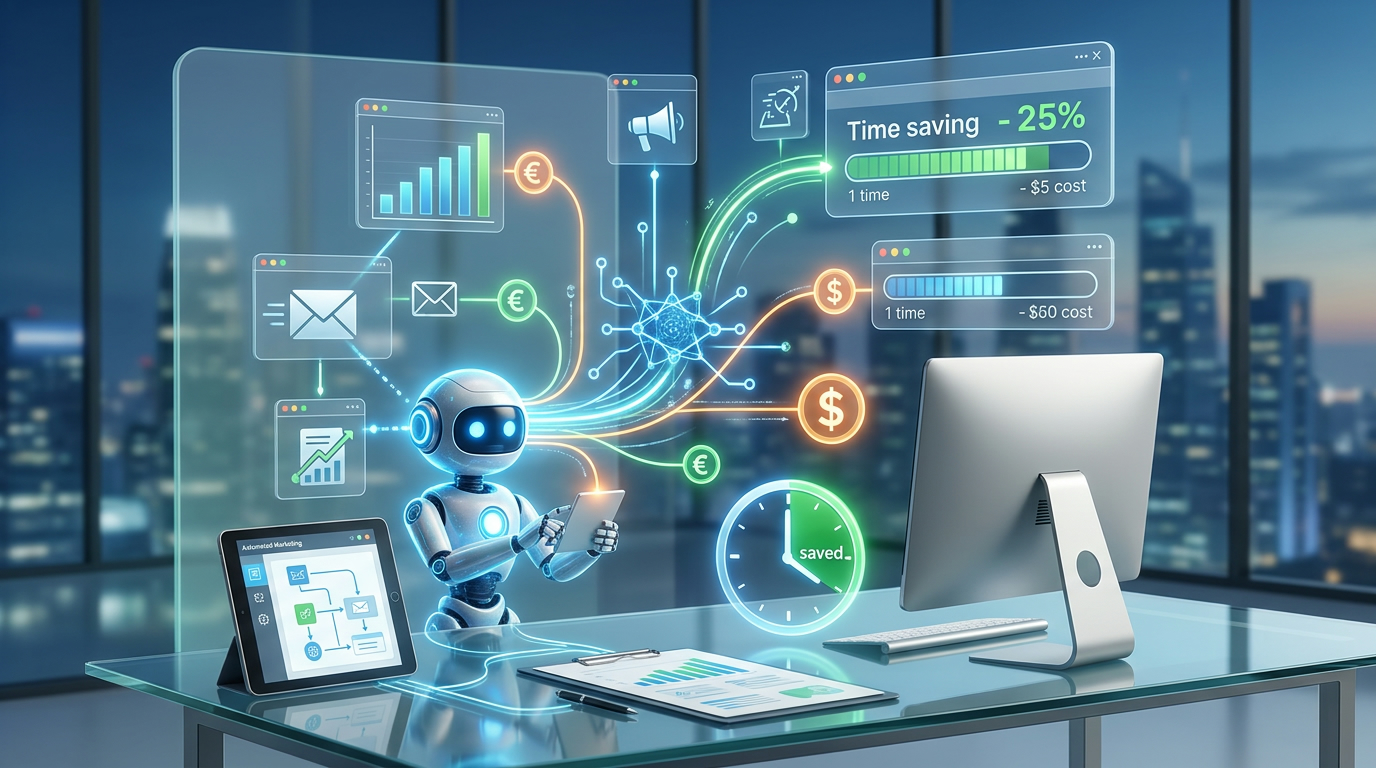
The Death of the Junior Marketer and the Dawn of Agentic Workflows
Imagine sitting down with your coffee at 8:00 AM on Monday, and instead of scrolling through an endless to-do list, a concise report is waiting in your inbox: "Today’s ten social media posts are ready, all graphics have been generated, ad copy has been optimized based on overnight conversion data, and a blog post draft reacting to latest industry news is awaiting your approval." All of this happened without sending a single internal message to your team. This wasn't the work of low-cost offshore labor; it was a software suite that has learned how to think.
Until now, AI in the marketing world has functioned primarily as a sophisticated typewriter. We asked ChatGPT to write a post, then we manually copied it into Facebook. That era ended yesterday. We have entered the age of Autonomous AI Agents (Agentic Workflows), where technology no longer just makes suggestions—it independently executes entire workflows from research to publication.
What is WaaS, and Why Will it Disrupt the Traditional SaaS Model?
For the past decade, we have lived in the SaaS (Software as a Service) era. We subscribed to Canva, Hootsuite, and Mailchimp. We paid for the privilege of doing the work ourselves within those tools. WaaS (Workflows as a Service) flips this logic on its head. In this model, you don't rent a tool; you hire the outcome.
Why would an SME pay for complex newsletter software when they can hire an AI agent that writes, segments, and sends emails three times a week while constantly monitoring the competition? The focus has shifted from "how do I do this?" to "get it done." Modern LLMs (Large Language Models) no longer just generate text; they communicate with other software via APIs (Application Programming Interface). They generate images using media.isi.studio, mine data from Google, and schedule posts across Meta platforms autonomously.
Under the Hood: How a Marketing Agent "Thinks"
Many assume AI automation is just a series of complex "if-then" statements. In reality, it is far more advanced. A modern autonomous marketing agent operates through a reasoning loop. When you give it a goal—such as "Increase our organic reach on LinkedIn"—the agent doesn't just start writing. It breaks the task into sub-goals:
- Research: It analyzes trending topics in your industry on platforms like Reddit or X (Twitter).
- Strategy: It selects three themes that align with your brand voice.
- Visual Content Production: Since visual engagement is critical, the agent uses the media.isi.studio API to generate high-fidelity images or short videos tailored to the context.
- Iteration: It writes a first draft, critiques its own work (yes, AI can self-correct!), and refines the tone.
- Execution: It uses tools like Make.com or Zapier to publish the content at the optimal time.
This process eliminates creative blocks and manual data entry. This isn't about the machine "stealing" work; it’s about liberating marketers from soul-crushing, repetitive tasks. Honestly, who still wants to manually curate hashtags or fiddle with UTM parameters?
The Secret to Massive Profit Margins: 60-80% Cost Reduction
Let's look at the numbers, because business is about ROI (Return on Investment), not emotions. In a typical marketing agency, labor hours account for the majority of costs. If preparing a campaign takes a junior staffer 20 hours, autonomous agents can reduce that to 2 hours (primarily for oversight).
This means an agency can provide the same service with one-tenth of the resources—or better yet, serve ten times as many clients with the same headcount. Companies are no longer buying software licenses; they are hiring outcome-oriented AI agents. This "Rental Agent" model is one of the biggest business opportunities of 2025. You aren't selling software; you are selling a "digital employee" who never takes a vacation and never asks for a raise.
How to Build Your Own Agent on a Budget
You don't need to be a developer to launch your first agent. With today's no-code tools, you can assemble a system in an afternoon that outperforms an entry-level social media manager. You will need a Make.com subscription, an OpenAI API key, and a creative engine like ISI Studio to provide professional visual output.
- Step 1: Connect Google Trends to GPT-4o.
- Step 2: Instruct the AI to analyze trends every morning and draft relevant posts.
- Step 3: Send the prompt to an image generator for unique, branded graphics.
- Step 4: Set up a "Human-in-the-loop" approval button via Slack or email before the system posts.
This hybrid model is the safest and most efficient way to start. You maintain control, but the grunt work vanishes.
The Dark Side: Will We Be Flooded with AI Junk?
Here is the controversial reality: if everyone uses AI agents, won't the internet become diluted? Absolutely. In fact, "content inflation" is already happening. If you simply leave the machine to work without adding a unique perspective or real value, your brand will become invisible. Algorithms—especially Google and TikTok—are increasingly punishing generic, soulless content.
The winners won't be those who pump out the most posts, but those who use AI for hyper-personalization. Your agent shouldn't write "one" post; it should write a thousand variations, each tailored to a specific micro-segment and their unique pain points. This is the kind of scalability that was humanly impossible before now.
The Future of the Marketer
The question everyone asks: "Will AI take my job?" The honest answer: it will take your tasks, but not necessarily your job. If your value was purely execution—simply "posting"—then your role is at risk. However, the marketer who learns to act as an AI Orchestrator—one who knows how to instruct agents, fine-tune strategy, and inject human empathy into the process—will be more valuable than ever.
In 2025, marketing is no longer about pushing creative buttons; it’s about designing systems. Autonomous agents are not the enemy; they are the most powerful weapons we’ve ever had. The only question is: will you build them, or watch your competition pass you by?
Glossary
- AI (Artificial Intelligence)
- A collective term for systems that perform cognitive functions similar to humans.
- LLM (Large Language Model)
- A model like GPT-4 trained on vast amounts of data to understand and generate human-like text.
- WaaS (Workflows as a Service)
- A model where software doesn't just provide a tool, but executes an entire business process.
- SaaS (Software as a Service)
- A cloud-based software subscription model.
- API (Application Programming Interface)
- An interface that allows different software systems to communicate with each other.
- ROI (Return on Investment)
- A performance measure used to evaluate the efficiency of an investment.
- Reasoning Loop
- The ability of an AI to break down a task into steps and audit its own performance.
- No-code
- Development environments that allow users to build software solutions without programming knowledge.
- Human-in-the-loop
- An automated process that requires human intervention or approval at a specific stage.
- UTM Parameter
- Tracking tags added to URLs to identify the source of web traffic.