Drone War 2.0: Why AI Software Wins Over Hardware
Swarm AI and autonomous drone software are rewriting the rules of the defense sector. Learn why code is the ultimate weapon in modern warfare. Explore more now!
The Buzzing Army Without a Remote Control
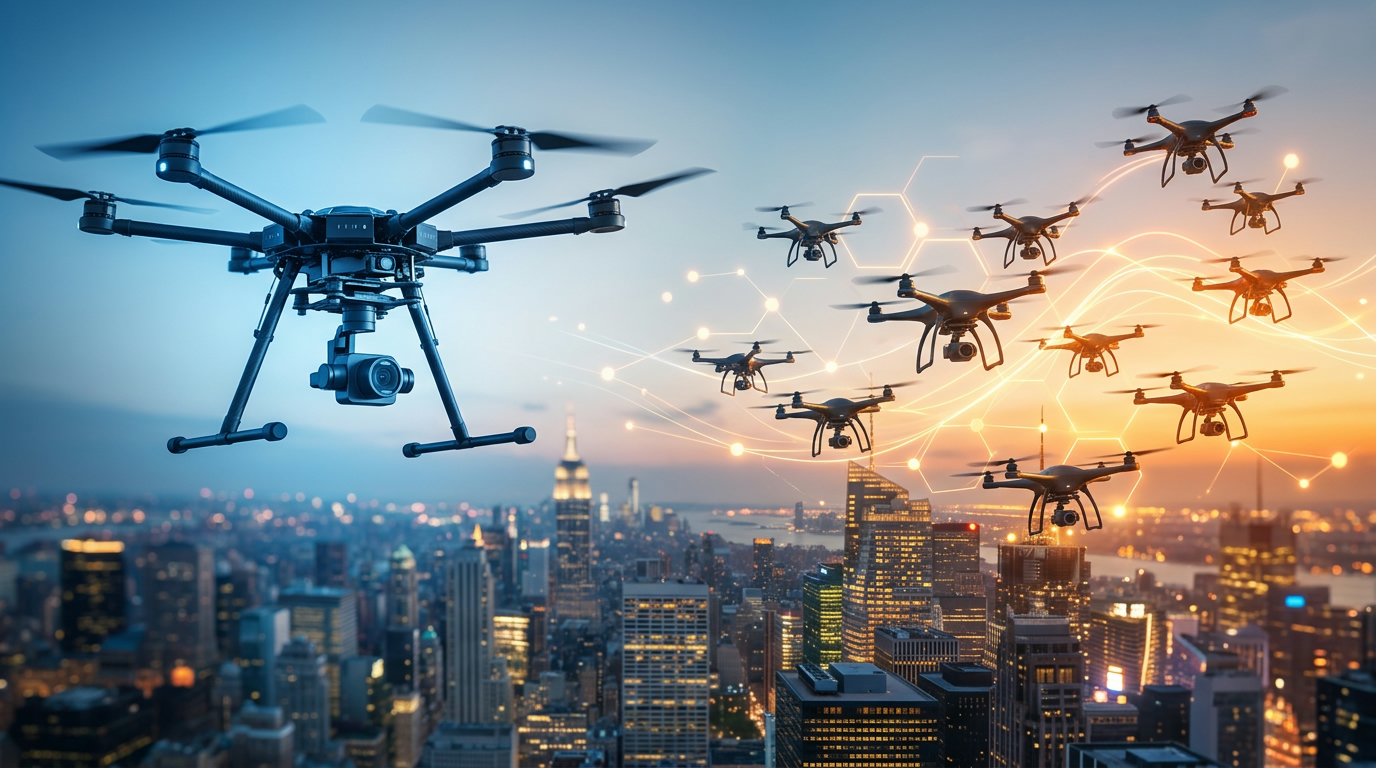
Imagine a single operator in a darkened room deploying five hundred small, low-cost units with a single touch. These machines don't wait for manual commands. They don't rely on GPS signals, and they don't panic when an adversary activates electronic jamming stations. They move as a single, coherent organism—resembling a murmuration of starlings across an autumn sky—yet they identify targets with lethal precision. This isn't a scene from a sci-fi thriller; it is the reality of Swarm AI (swarm-based artificial intelligence) currently rewriting the rulebook of warfare and private security from the Ukrainian steppes to the laboratories of Silicon Valley.
Google Trends data confirms the shift: search interest for "autonomous drone navigation" and "swarm intelligence" has skyrocketed. The reason is simple: the era of multi-million dollar fighter jets and tanks is being challenged by $500 drones powered by sophisticated software. The focus has shifted from "iron" to "code." In this sector, victory doesn't go to the one with the most aluminum, but to the one who writes the most intelligent algorithm.
Hardware Democratization: The Frame is Just a Box
Drones were once synonymous with prohibitively expensive, military-grade hardware. Today, anyone can purchase stable frames and efficient motors off the shelf. Hardware has become a commodity. The true value—the high-end differentiator—is now the software module that empowers these inexpensive devices with autonomous decision-making capabilities.
The essence of Swarm AI Systems-as-a-Service (SaaS) is a platform-independent "brain" that can be deployed on any existing drone hardware. Think of it as the Windows or Android of drones, capable of coordinating thousands of units without collisions. When a security firm or government agency invests in a fleet, they aren't primarily buying rotor efficiency; they are buying Edge AI—the ability to recognize an intruder at a perimeter without needing a cloud connection.
In this new landscape, visual communication and simulation are critical. Selling these complex systems to stakeholders requires high-impact, clear visualization. The tools at media.isi.studio are specifically designed to showcase software capabilities through hyper-realistic videos, convincing investors of a system's efficacy long before the first field deployment.
Electronic Warfare (EW) and the Autonomy Paradox
A primary lesson from modern conflicts is the overwhelming power of EW (Electronic Warfare). If a drone relies on remote control or GPS signals, it becomes a flying paperweight the moment a jammer is activated. This is where autonomous navigation becomes essential. Software utilizing Computer Vision can navigate without external signals by seeing the terrain, recognizing landmarks, and cross-referencing them with internal maps.
- Sensor Fusion: The software simultaneously analyzes optical, thermal, and ultrasonic data.
- Collective Intelligence: If one member of the swarm is jammed, others take over its tasks and share their sensor data.
- Zero Latency: Because decision-making happens locally on the edge, there is no need for back-and-forth command transmission.
This level of autonomy is critical not only on the battlefield but in protecting critical infrastructure. A drone swarm guarding a gas pipeline or a solar farm must function even if the local network is sabotaged. This software scalability is transforming the industry into a multi-billion dollar market.
The Business Model: Scalability is King
Why is Swarm AI such a lucrative business model? Because the marginal cost of software—the price of installing it on one more unit—is effectively zero. While manufacturing a drone requires physical materials and time, duplicating a license key is instantaneous.
The giants of the future won't be drone manufacturers, but software houses. These companies will provide API (Application Programming Interface) solutions that integrate existing security cameras and drone swarms into a single, unified defense grid. However, this technological leap cannot be sold with boring PDFs. Marketing must match the AI revolution. ISI Studio’s AI-powered video generation technology allows companies to make complex software processes—such as how a swarm coordinates during object recognition—understandable and visually stunning for civilian and corporate clients.
Where are the Market Gaps?
- Agricultural Swarms: Precision spraying and pest monitoring conducted by hundreds of units simultaneously.
- Logistics Networks: Urban package delivery where drones communicate with each other to avoid mid-air collisions.
- Private Security: Autonomous patrolling of vast estates where the software distinguishes between local wildlife and an actual intruder.
The Future is in the Server Room, Not the Air
A common question is: "What about safety? What if the swarm goes rogue?" The answer is that a software-driven approach is inherently safer than manual control. Algorithms don't get tired, they don't get nervous, and they don't make human errors under stress. Deep Learning constantly refines swarm behavior, making the system smarter with every flight hour.
The question is no longer whether drone swarms will become mainstream, but who will own the "brain" that moves them. The companies investing in software development and AI-based visualization today will be the defense and industrial titans of tomorrow. The Wright brothers built the machine, but modern aviation was made safe and scalable by the software running in the cockpit. That same shift is happening in the drone industry right now.
If you want to be part of this digital and physical revolution, start with your visual presence. Showcase your innovations with ISI Studio and prove to the world that your code is what will dominate the skies of the future.
Key Terminology
- Swarm AI
- Artificial intelligence where many simple units collaborate to achieve complex, collective behaviors.
- Edge AI
- AI that runs directly on the device (e.g., the drone) rather than on a remote server.
- EW (Electronic Warfare)
- Military action involving the use of electromagnetic energy to determine, exploit, or reduce an opponent's use of the spectrum.
- Computer Vision
- A field of AI that enables computers to derive meaningful information from digital images or videos.
- SaaS (Software-as-a-Service)
- A software licensing and delivery model in which software is provided on a subscription basis.
- API (Application Programming Interface)
- A set of rules that allows different software entities to communicate with each other.
- Deep Learning
- A subset of machine learning based on artificial neural networks with multiple layers.