GPT-5.4: The Future of Creative AI and Content Production
Discover the GPT-5.4 revolution in AI content generation. Create professional text, images, and video with https://media.isi.studio. Click to read the future!
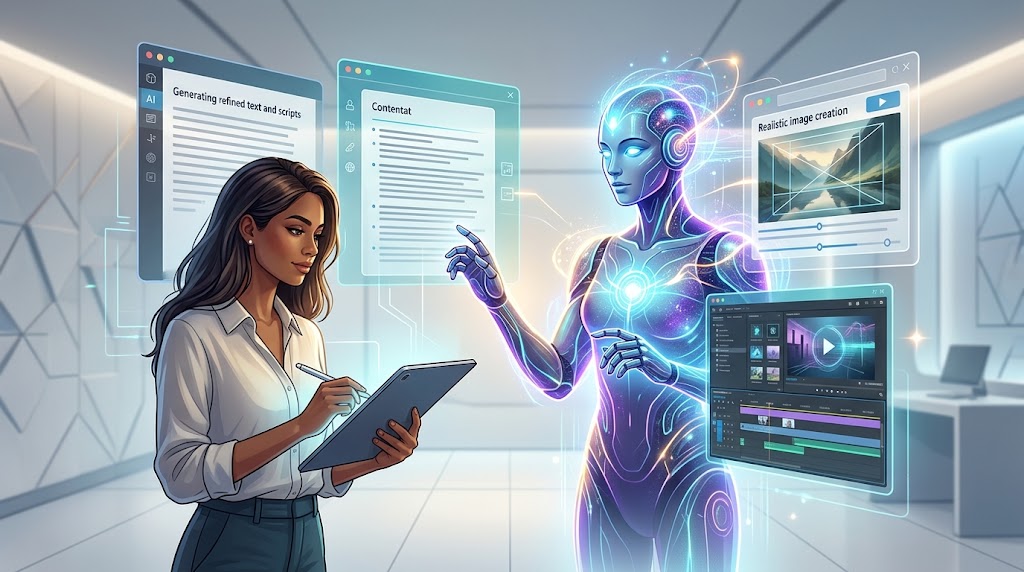
Beyond the Turing Test: When Machines Dream, Not Just Imitate
Forget everything you thought you knew about chatbots. Late last year, I was having coffee with a screenwriter friend in Hollywood who dismissively remarked, "A machine will never understand melancholy." Two weeks later, after reading a draft generated by GPT-5.4 (Generative Pre-trained Transformer 5.4 — OpenAI’s latest generative model), he was moved to tears. It wasn't because the software had become sentient, but because GPT-5.4 no longer simply calculates word probability; it constructs contextual emotional arcs. Content production is no longer a linear struggle over a blank page; it has become a symbiotic dance between human inspiration and raw, infinite computational power.
Is this the twilight of the creative professions? Quite the opposite. It is the dawn of an era where technical barriers—lack of drawing skills, the complexity of editing suites, or the cost of composition software—are finally collapsing. GPT-5.4 and platforms like media.isi.studio are creating a democratized creative space where the idea is the only true currency.
GPT-5.4: More Than a Simple Text Engine
While previous models often left a "robotic" aftertaste, version 5.4 (an iteration or development cycle in software engineering) offers something entirely different. Multimodality—the ability to handle multiple inputs and outputs like text, image, and sound simultaneously—is no longer just a marketing buzzword. This model understands visual metaphors. If I ask it to "write a scene as if directed by Wes Anderson in a cyberpunk Tokyo," I don't just get dialogue. I get color hex codes, precise camera angles, and an accompanying score pulsing at exactly 112 BPM (Beats Per Minute—the tempo of the music).
Consider this: a single marketer can now execute an entire campaign from scratch. Copywriting, ad graphics, promotional videos, and background scores. This isn't the distant future; this is Tuesday morning. AI content generation is no longer about "copy-pasting"; it’s about curation. The question is no longer "Can you write?" but "Do you know what to ask?"
The Multimedia Explosion: From Text to Reality
The most exciting frontier is undoubtedly visual content. The boundaries of digital art are blurring. Remember spending hours searching for a stock photo that was "almost" right? Today, via the media.isi.studio interface, you can generate photorealistic images or short videos in seconds—assets that would have previously required multi-million dollar studio budgets. The GPT-5.4 creative engine interprets subtle nuances: the angle of light, the grain of textures, or the micro-emotions reflected on a character's face.
- Personalized Video Ads: Imagine every visitor to an e-commerce site receiving a unique video where the model says their name and the environment reflects their past purchases.
- Interactive Scripts: VR (Virtual Reality) experiences where the narrative shifts dynamically based on every word the player speaks. No pre-written script—only real-time reactions generated by GPT-5.4.
- Musical Compositions: Background music for podcasts that automatically adapts to the speaker's tone and the gravity of the topic.
This level of creative AI usage fundamentally rewrites the concept of ROI (Return on Investment) in marketing. Production costs are plummeting while relevance and quality are reaching new heights. Those who don't adapt now won't just fall behind—they will become invisible.
The Era of "Creative Data": Why Everyone Is a Producer
Let’s be bold: in the future, we may not need "copywriters" or "graphic designers" in the traditional sense. Instead, we will see "Prompt Engineers" (specialists who master the art of instructing AI to achieve specific results) and creative strategists. Creativity isn't being lost; it is being transformed. The machine provides the muscle; the human provides the direction.
The ISI Studio platform builds exactly this bridge. It allows a small business owner to construct a visual narrative (storytelling style) around their brand that was previously the exclusive privilege of companies like Coca-Cola or Apple. GPT-5.4 analyzes market trends, suggests the most effective "hooks" (opening lines or visuals designed to grab attention), and then produces them. This efficiency might be daunting to those clinging to routine, but it is liberating for those with ideas who lacked the technical background to execute them.
The Contrarian View: The Boredom of Perfection
There is, however, a trap few discuss. If everyone uses AI to produce content, everything becomes "perfect." And perfection, after a while, is boring. Our eyes will adjust to flawless AI-generated faces and mathematically calibrated ad copy. What will the new luxury be? The mistake. Human imperfection. In the future of digital art, we won't use GPT-5.4 to replace the human element, but to amplify what makes us unique. The best creators will be those who know when to let the machine "fail" or how to introduce intentional asymmetry that makes the result feel alive.
The Danger Zone: Ethics, Authorship, and the Price of the Human Touch
We cannot ignore the difficult questions. Who owns the copyright if GPT-5.4 writes a hit song? What happens with Deepfakes (synthetic media where a person's likeness is replaced with someone else's)? The responsibility is greater than ever. This technology puts power in our hands that can destroy or build reputations in minutes. Ethical AI use is not an option; it is a prerequisite for survival.
For content creators, the ultimate challenge remains maintaining authenticity. Audiences can sense when there is no real intent behind content, only a well-written algorithm. This is why ISI Studio is not just software, but an ecosystem that helps find the balance between machine speed and human soul. Remember: AI is a piano. You can play "Chopsticks" on it, or you can play Liszt. The difference is the pianist.
Business Strategies in a Post-AI World
How should you start today? If you are a marketer, do not fear GPT-5.4. Test it, push its limits. Use it for research, drafting, or generating a newsletter in five different styles. If you are an artist, view AI as an assistant that never tires and has every visual reference in human history at its fingertips.
- Iteration Speed: What used to take a week to plan now takes ten minutes. Use that saved time for strategic refinement.
- Personalization at Scale: Stop producing "mass-market" goods. The technology for hyper-personalization is here.
- Value-Based Pricing: Move away from hourly rates. Your clients care about the impact on the market, not how long it took to render the video.
In closing: GPT-5.4 won't take the job of anyone capable of evolving. But the content creator who uses AI will take the job of the one who doesn't. The new era of creativity is not about machines; it’s about us—humans finally freed from monotony to focus on what we do best: dreaming and creating.
Glossary
- GPT-5.4 (Generative Pre-trained Transformer 5.4)
- OpenAI's latest generative language model, capable of complex textual, visual, and logical tasks.
- Multimodality
- A system capable of processing and generating multiple types of data (text, image, audio, video) simultaneously.
- Prompt Engineering
- The science and art of precisely formulating instructions for AI models to achieve desired outcomes.
- Deepfake
- Video or audio recordings created with AI that show someone saying or doing something that never actually happened.
- ROI (Return on Investment)
- A performance measure used to evaluate the efficiency or profitability of an investment.
- BPM (Beats Per Minute)
- A unit used to measure the tempo of music, indicating the number of beats in one minute.
- Iteration
- A series of repeated steps in development or creation where the result is gradually improved.