YouTube AI Dubbing: Scaling Your Content Globally
Master AI dubbing and lip-sync for YouTube. 10x your revenue with global content strategies. Explore professional AI solutions at ISI Studio today!
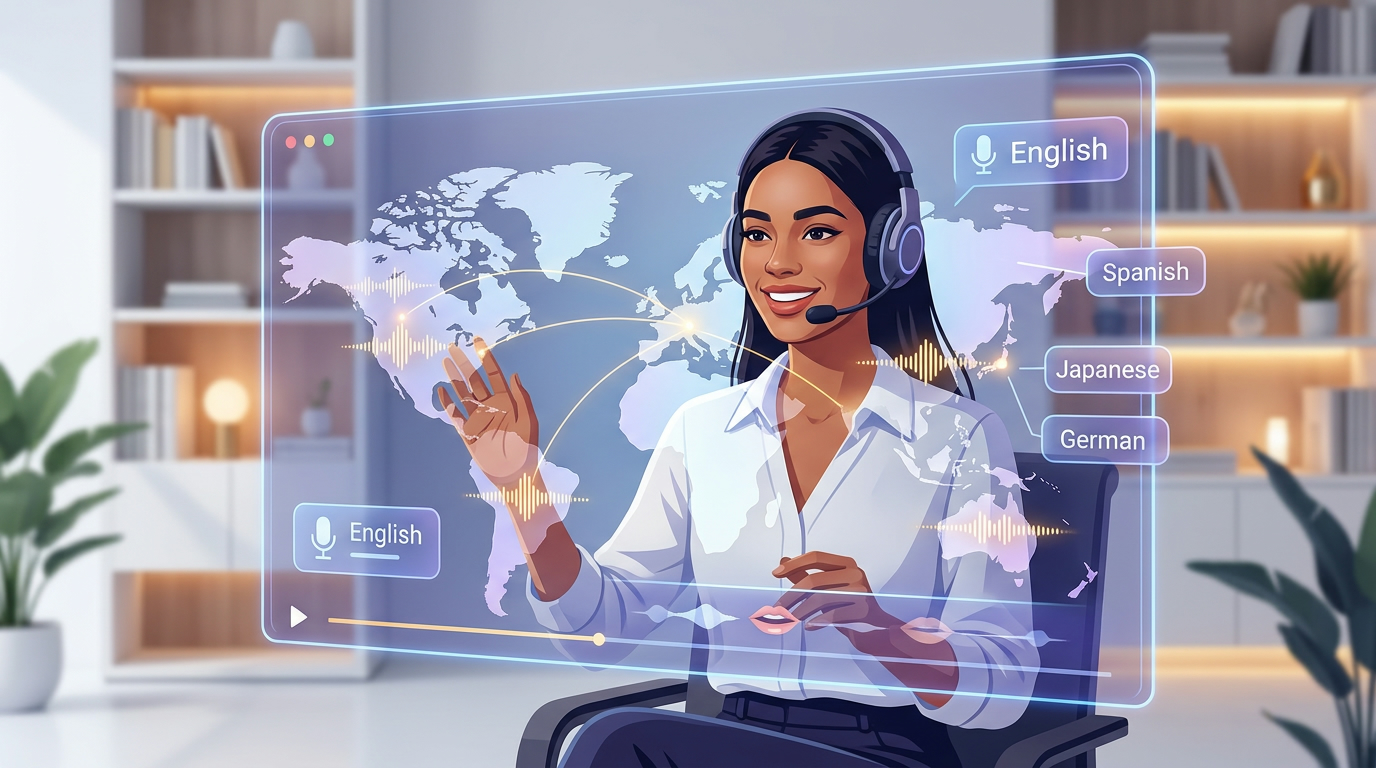
The End of the Language Barrier: Why Local Markets Are No Longer the Limit
Imagine your latest video not only reaching your local audience but greeting viewers in Mexico in Spanish, debating tech trends with Berliners in German, and doing it all in your own voice, with perfect pronunciation and original emotional depth. This isn't a sci-fi scenario or the result of a million-dollar dubbing studio. This is the current reality where AI (Artificial Intelligence) has permanently dismantled language barriers for content creators. Let’s be honest: producing content in a single local language, no matter how rich, is a business bottleneck. Limiting yourself to a few million potential viewers in a world where YouTube algorithms reach billions is simply leaving money on the table. Until now, global success required near-perfect English or an expensive translation team. But what if you could decuple your market reach with the push of a button?
A new era of Global Scaling has arrived. While platforms like YouTube are already experimenting with multi-language audio tracks, the real breakthrough comes from generative AI. We are no longer just talking about subtitles—which half of viewers ignore anyway—but a total audiovisual experience. The question is no longer whether you should think globally, but who will be the first to capture the Spanish, English, or Hindi niches in your industry while others are still confined to local markets.
The Technology: Not Just Translation, But Digital Reincarnation
When discussing AI-based dubbing, many still think of the robotic, monotonous voices of the past. Today’s technology is light-years ahead. The heart of the process lies in voice cloning and Lip-Sync (synchronizing lip movements). Let's examine the technological chain that allows a creator to speak authentically in any language.
ElevenLabs and the Art of Voice Cloning
ElevenLabs is a pioneer in the industry. This platform can create a digital twin of your voice using just a few minutes of samples. Using STS (Speech-to-Speech) technology, it doesn’t just translate words; it preserves your timbre, speech tempo, and, most importantly, your emotional inflection. If you are energetic in the original video, your Spanish AI voice will be energetic too. This emotional coherence is why viewers don’t feel the content is artificial. On YouTube, authenticity is the most valuable currency.
HeyGen and Visual Illusion: The Perfect Lip-Sync
Audio is only half the battle. There is nothing more distracting than audio that doesn't match the speaker's mouth movements. This is where HeyGen or Sync Labs come in. These tools modify the original video pixel by pixel so that your lip movements precisely follow the foreign language text. The result? A video where a native speaker cannot tell it wasn't originally recorded in their language. This level of visual manipulation, once reserved for Hollywood studios, is now available to anyone with a software subscription.
While specialized tools handle voice and movement, you can perfect the visual package—such as eye-catching thumbnails and in-video illustrations—using the advanced generative tools at media.isi.studio. After all, perfect German dubbing won't help if your thumbnail fails to grab attention in a global feed.
The Math of Global Content: 5x to 10x Revenue Growth
Let's talk about the business side, as revenue drives sustainable creation. Many local markets suffer from low CPM (Cost Per Mille). A creator in a smaller market might earn a fraction of what an American, German, or Australian creator makes for the same thousand views. In the US, finance or tech channels can run with a $20-$30 CPM. This means the same video that earns you $100 locally could generate $1,000 on the global market.
- Ad Revenue: YouTube AdSense pays based on the viewer's location. If your video runs with a Spanish dub and is viewed in Mexico or Spain, you earn those specific market rates.
- Global Sponsorships: A local channel attracts local sponsors. A multi-language channel enters the radar of global brands.
- Affiliate Opportunities: Systems like Amazon Associates scale significantly when you speak to markets where these services are ubiquitous.
The ROI (Return on Investment) here is undeniable. Localizing a video with AI now costs a fraction of its potential revenue increase. This type of content arbitrage is currently the biggest business opportunity in digital media.
Building a Business: The Localization Agency Model
This creates a massive entrepreneurial opportunity. Many excellent creators have neither the time nor the technical affinity to experiment with AI tools. This is where you can step in as a specialized localization agency. The model is simple: take existing high-performing videos and "globalize" them. Don't just translate; manage their global presence.
During this process, you must optimize visual elements alongside the audio. The media.isi.studio platform is a perfect partner for generating unique, market-specific visual assets for foreign channels. A viewer in Japan responds to different visual triggers than one in Brazil. AI makes this mass production seamless. Offering "Localization-as-a-Service" is set to be one of the hottest trends in 2024 and beyond.
The Cultural Trap: What AI Doesn't Understand (Yet)
Don't fall into the trap of thinking AI solves everything. Human intelligence remains unbeatable in one area: context. A joke that works in London might be confusing in Madrid. A metaphor used in New York might mean nothing in Mumbai. This is why a "human-in-the-loop" approach is critical. AI handles 90% of the work, but the final 10%—the fine-tuning—requires a human touch.
The biggest mistake is using raw, unverified machine translation. Always verify text generated by LLMs (Large Language Models like GPT-4). Use prompts that specifically request cultural adaptation. For example: "Translate this into Mexican Spanish, use youth slang, and replace local cultural references with regional equivalents." This is the difference between a low-quality spam channel and a professional international brand.
Conclusion: The Future Belongs to Those Who Speak Globally
At this stage of technological development, language is no longer a barrier; it's simply a setting. Those who ignore AI-based dubbing and lip-sync technology are voluntarily ignoring 99% of the world's viewers. The world has opened up, and creators have the chance to move beyond the boundaries of their home turf. Whether it's an educational platform, an entertainment channel, or B2B marketing, localization is the new standard.
Start small: choose one target language, localize your top-performing videos, and watch the analytics. Use modern tools for visual content development by visiting media.isi.studio to see how AI can support your global expansion. Remember: the YouTube algorithm doesn't care where you live—it only cares if the content engages the viewer. If the content is great and the viewer understands it, the sky is the limit.
Glossary
- AI (Artificial Intelligence)
- A collective term for systems based on machine learning.
- API (Application Programming Interface)
- An interface that allows different software applications to communicate.
- CPM (Cost Per Mille)
- The cost per thousand impressions in advertising systems.
- Lip-Sync
- The synchronization of mouth movements with audio in a video.
- LLM (Large Language Model)
- Large-scale language models, such as GPT-4 which powers ChatGPT.
- ROI (Return on Investment)
- A performance measure used to evaluate the efficiency of an investment.
- SaaS (Software as a Service)
- A software licensing and delivery model in which software is provided on a subscription basis.
- STS (Speech-to-Speech)
- Voice-to-voice generation where the characteristics of the source voice are preserved.
- TTS (Text-to-Speech)
- The generation of human-like speech from written text.